
Solutions · Certificate Lifecycle Management
47‑day certificates are coming. Is your team ready?
Certificate Lifecycle Management (CLM)
As of March 2026, public TLS certificate lifetimes dropped to 200 days, and they keep shrinking. Organizations that prepare now won’t scramble later. Find out in three minutes where you stand.
For CIOs, CISOs and IT leaders responsible for public certificates.
Maximum TLS certificate lifetime
8× more renewals by 2029. Manual renewal becomes impossible at scale.
The deadline
Three dates every certificate owner should know
March 2026
Maximum TLS certificate lifetime drops to 200 days.
March 2027
100 days. Renewals double in frequency.
March 2029
47 days. Manual renewal becomes impossible at scale.
Preparing now gives your team time to adapt, automate and stay ahead. Don’t wait until certificate renewals become a daily challenge.
The problem
Why this matters
More renewals by 2029
Going from 398-day to 47-day lifetimes multiplies renewal work 8-fold. Most teams are not ready for this.
Of certificate outages are preventable
They happen because no one had a complete, live view of what was about to expire.
Person holds the knowledge
In most organizations, certificate knowledge lives in one person’s head or one spreadsheet: a single point of failure.
The solution
How CLM works: 3 steps from chaos to full control
1 · Discover everything
We map your entire certificate estate. What you have, where it lives, when it expires. Most organizations find certificates they did not know existed.
2 · Get clear insight
One view of every certificate, owner and expiry date. No spreadsheets, no guesswork, just a clear picture of where you stand.
3 · Automate the rest
Renewals happen automatically before certificates expire. No manual tracking, no last-minute scrambles, no outages.
Interested in early access to BlueX Online?
BlueX Online is AET Europe’s certificate lifecycle management platform — built to give your team full visibility and automated control over every certificate in your environment. Explore BlueX Online
Learn more
Insights on shrinking certificate lifetimes
Certificate Chaos: How Shrinking Validity Windows Are Exposing Critical Gaps for CISOs
Digital certificates protect everything from websites to critical infrastructure, yet shrinking validity creates unseen risk.
Read the article → InsightsTLS Certificate Lifetimes Are Already Changing: What Your Team Needs to Do Now
How digital trust depends on discovering, managing and renewing certificates before failures occur.
Read the article → UpdatesNew release of SafeSign IC 4.7.0.0
We are happy to announce the release of SafeSign IC 4.7.0.0.
Read the article →
Free e-book
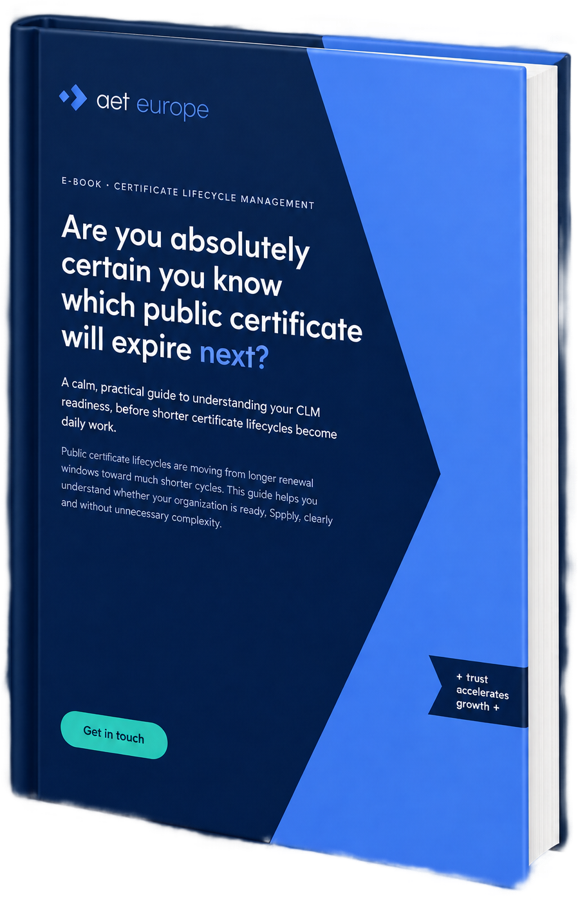
Are you absolutely certain you know which public certificate will expire next?
A calm, practical guide to understanding your CLM readiness. What is inside:
- ✓ Why shorter lifecycles change the game for every team
- ✓ The three questions every CIO and CISO should ask
- ✓ Signs you may need better lifecycle management
- ✓ What BlueX Online delivers, in time and money
FAQ
Frequently asked questions
What happens when a certificate expires?
Browsers and systems immediately stop trusting it — there is no gradual degradation. Services show security warnings, APIs refuse connections, and applications break without warning.
Why are certificate lifetimes getting shorter?
The CA/Browser Forum, backed by Apple, Google, Microsoft and Mozilla, has mandated shorter lifetimes to reduce the risk of compromised certificates being exploited. As of March 2026, the maximum is 200 days. By 2029 it will be 47 days.
What changed on March 15, 2026?
Newly issued public TLS certificates may be valid for a maximum of 200 days. This drops to 100 days in March 2027, and 47 days in March 2029.
What is BlueX Online?
BlueX Online is AET Europe’s certificate lifecycle management platform. It is designed to give organisations full visibility and automated control over their certificate estate.
How can AET Europe help us prepare?
Start with the free CLM Readiness Assessment on this page. Our specialists can then review your current certificate setup, assess your exposure to the 2026 deadline, and advise on the right approach for your organisation.
Ready to talk?
Not sure where to start? Let’s talk.
Our specialists can review your current certificate setup, walk you through what the 2026 changes mean for your organisation, and show you what AET Europe is building to help.
Get expert guidanceOr call us directly: +31 26 365 33 50
Not ready yet?
Get clarity first, at your own pace
Start with the three-minute readiness check, or take the e-book with you for your team and board.